Fashion and the Arts Creating Equity (FACE) is a not for profit organisation, dedicated to championing equity, inclusivity and unity within higher education. co-founded by Sharon D. Lloyd, Associate professor deputy director for the centre of equity London Metropolitan University. PASCAL MATTHIAS Academic, Fashion Industry EDI Lead, Champion, and Consultant; Associate Vice President for EDI and Social University of Southampton and Awareness and Accountability EDI Consultant, Senior Teaching Fellow Winchester School of Art. Andrew Ibi Course Leader Liverpool John Moores University
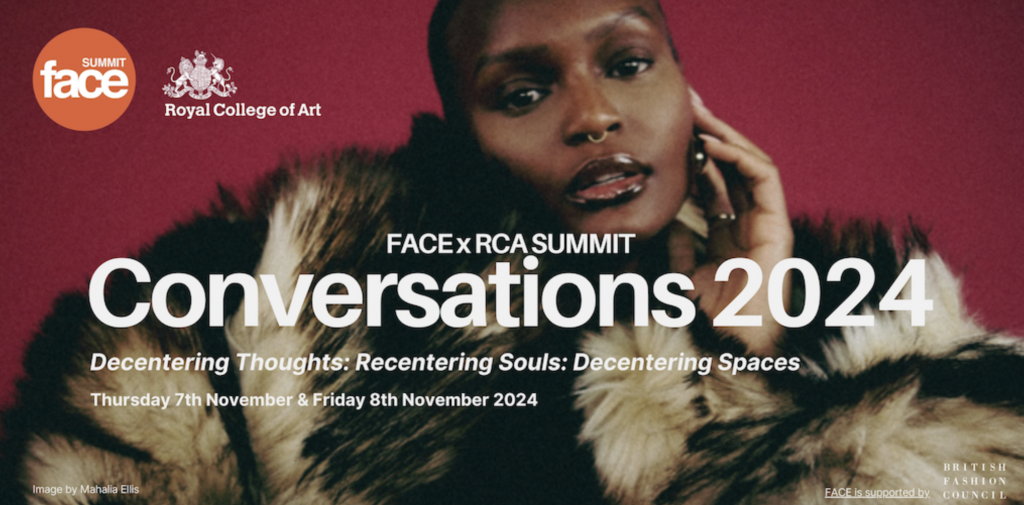
The FACE (Fashion Academics Creating Equity) Summit was held over two days November 7th & 8th at the Royal College of Arts Batersea campus.
The summit was a programme created to encourage insightful creative discussions and network opportunities. Talks and workshops were given by industry leaders, innovators and RCA alumni including myself. Full Programme here The summit was given the overarching title of ‘Conversations 2024’ with a sentence on communications that read: Decentering Thoughts: Recentering Souls: Decentering Spaces.
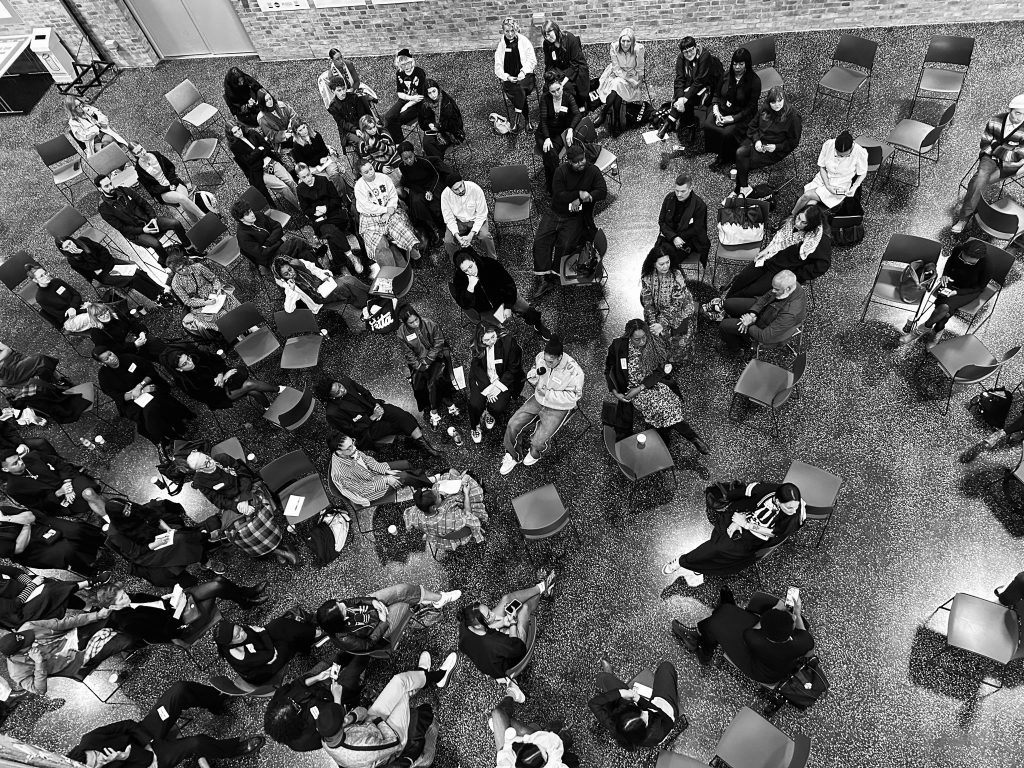
This concept of ‘decentering’ was a key idea throughout the two-day summit, the premise was to take a decentred approach to the summit that promoted and encouraged a democratic, non hierarchical dialogue between all participants.
All discussions/ presentations that took place were arranged having the panel members/presenter’s situated in the middle of the space with the other participants free to arrange their sitting as they liked to garner their best advantage point for engagement in talks and activities. There was a chair purposefully empty in the middle of the room next to the panel members/presenter’s for anyone to move to and occupy if they wanted to ask/answer a direct question from the panel members/presenter’s.
Participatory Research, Thematic Analysis.
‘Thematic analysis is a qualitative analysis method used in the social sciences to identify and present recurring patterns or themes in data. It involves careful reading and interpretation of the material to extract meaning and understand different subjects and interpretations.‘
AI generated definition based on: Energy Research & Social Science, 2023
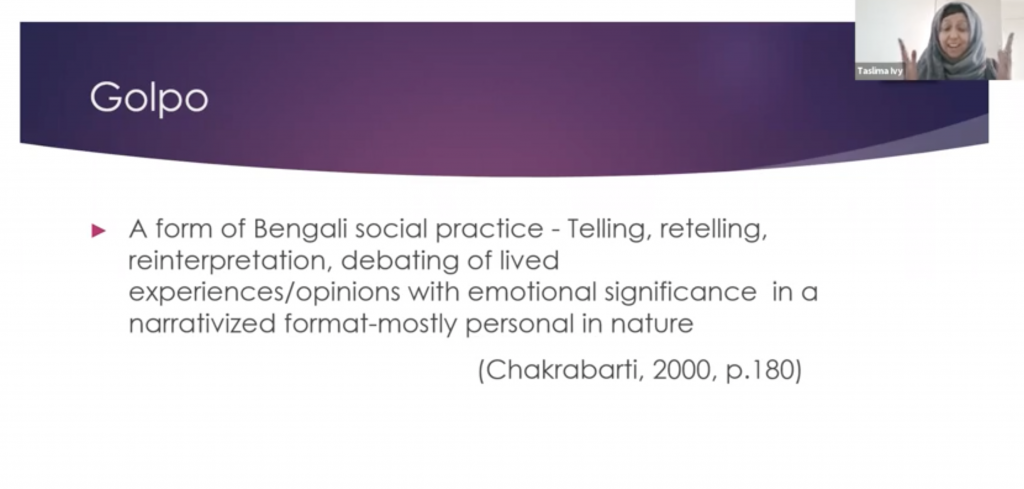
in ‘Participatory data gathering and co-analysing data with participants using thematic analysis‘ >53 minute video , Dr Ivy Taslima and Dr Fungisai Muchenje reflect on their experience of using participatory research methods in their PhD research. Dr Ivy Taslima explains the context of her doctoral research being focused on educational culture, in particularly the culture within the use of technology in rural Bangladesh where she grew up. Ivy explains that the culture of education in Bangladesh according to academic literature is portrayed as transformative, very one-way with the structure of the teacher talking and students listening, very passive with no interaction no fun and engagement. What drew me to Ivy’s research is her focus on ‘participatory space’ and how the space you interact and engage in with your participants (or students) can either promote inclusive practice or enhance some participants feeling of exclusion. Ivy looks at participatory methods of engagement but particularly indigenous methods, in particular the Bengali method of Galpo (Please see above screenshot).
“A context where we can engage in open critical dialogue with one another, where we can debate and discuss without fear of emotional collapse, where we can hear and know one another in the difference and complexities of experience.”
(Hooks 1994, p,110)
For my participatory research I’m interested in how to encourage inclusive practice by having a focus on participatory space, in order for my students to feel comfortable in sharing and participating in a group discussion. Like the FACE Summit and Dr Ivy Taslima’s research, i wish to focus on educational culture by creating a democratic non-hierarchical approach to the workshops agenda. Dr Ivy Taslima also talks about challenging the hierarchical nature of being the researcher and the researched by being more flexible to the notion of socially owned process, being engaged in emotional intellectual practice, i too agree with this idea and wish and aspire to align my teaching practice with these concepts. I will reflect on how effective this approach is in the form of a questionnaire.
Questionnaries
For my questionarre I adapted the work of Dr. Stephen Brookfield’s Critical Incident Questionnaire. This was recommended to me by Gabriel Miller, researcher and associate lecturer in fashion sustainability at London College of Fashion as well as a fellow member of FACE.
The critical incident questionnaire (referred to from this point on by its initials, the CIQ) is the instrument that Brookfield see’s as most helpful in allowing him to see the classroom through students’ eyes. It is a quick and revealing way to discover the effects your actions are having on students and to find out the emotional highs and lows of their learning. Using the CIQ gives a quick insight into what’s working and what’s misfiring, what you should keep and what you should discard, and how different students experience the same classroom activity in varying ways. It also provides you with running commentary on the emotional tenor of each class you deal with.
The CIQ is a single page form that is handed out to students once a week at the end of the last class you have with them that week. It takes about three to five minutes to complete and students are told not to put their name on the form. If nothing comes to mind as a response to a particular question they are told to leave the space blank. They are also told that at the next class I will share the group’s responses with them.
I used five CIQ questions with a sixth additional in reference to the sessions relativity to their ongoing unit work. The questions asked were as follows.
- At what moment in today’s session did you feel most engaged with what was happening?
- At what moment in today’s session were you most distanced from what was happening?
- What action that anyone (teacher or student) took today did you find most affirming or helpful?
- What action that anyone took today did you find most puzzling or confusing?
- What about the class today surprised you the most? (This could be about your own reactions to what went on, something that someone did, or anything else that occurs).
- Do you think making space for sessions like this would be beneficial for your ongoing work ? If your answers yes, why ?