Introduction
I’m a senior tutor, year 2 leader on the BA Textile Design course at Chelsea College of Arts. The main focus of my role is the following:
- Lead on the creation of engaging Unit project briefs and the subsequent timetable programming of relevant studio -based workshops that support the students successfully answering of the brief, meeting the assessment criteria & learning requirements.
- The pastoral care of the Y2 cohort throughout the academic year.
- Taking the lead on having an external, future facing industry perspective, actively reaching out to external practitioners for the BATDY2 students to engage with, embedding their best practice into our programme offering.
In my professional practice I’m a sports footwear designer who’s worked at a senior level in-house and as a consultant for the top global sportswear companies. As a male cis gendered black Londoner from a West Indian background, throughout my career, both in industry and academia I’ve been in the minority within the spaces I practice my trade.
Intervention
The intervention I’ve designed will take the form of the following:
- Part 1- BA (hons) Textile Design Year 2, Unit 5 project brief.
- Part 2 – A one-day workshop with BATDY2 students to support the learning outcomes of the brief lead by an external visiting textile practitioner and myself.
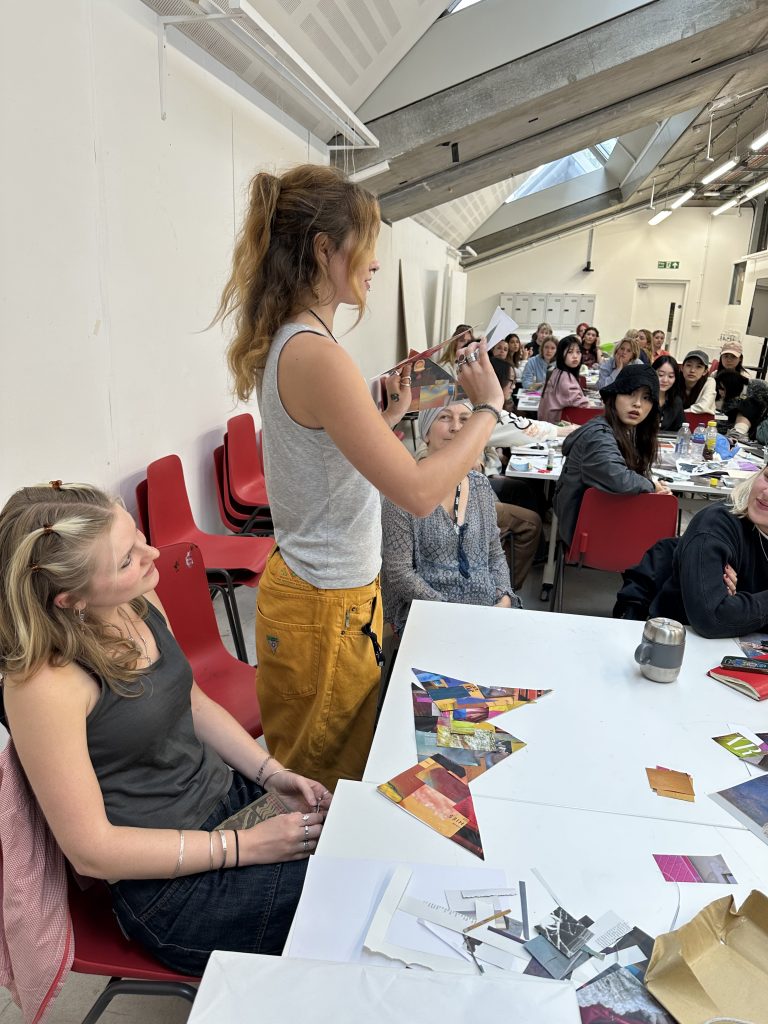
Image above : BATDY2 Students presenting to peers in a textile workshop.
Part 1 – Unit 5 Project Brief
Briefing; September 23rd, 2024
Submission; October 31st, 2024
Create your own textile- based representation of your identity in order to make a tangible expression of your positionality within your design practice. This textile representation should take the form of a ‘Fandom textile outcome’ such as the following:
- Flag or Banner
- Scarf
- Team Shirt.
‘A fandom is a subculture composed of fans characterized by a feeling of camaraderie with others who share a common interest. Fans typically are interested in even minor details of the objects of their fandom and spend a significant portion of their time and energy involved with their interest, often as a part of a social network with particular practices, differentiating fandom-affiliated people from those with only a casual interest.
A fandom can grow around any area of human interest or activity. The subject of fan interest can be narrowly defined, focused on something like a franchise or an individual celebrity, or encompassing entire hobbies, genres or fashions. While it is now used to apply to groups of people fascinated with any subject, the term has its roots in those with an enthusiastic appreciation for sports.’
(Wikipedia)
Aims
- To explore the concept of inclusivity.
- To be able to design a colour pallet around a narrative.
- To understand the historical context around colours/ flags.
- To create textiles (fandom textile outcome) that translates research into a tangible outcome.
- To consider material choices.
- To promote a culture of equality and empathy within the BATDY2 student cohort.
What you need to produce.
Based on your identified positioning/community:
- Create a positioning/community identity board using colour & material exploration.
- Produce six to eight textile samples and associated design development that leads to the production of a ‘fandom textile outcome’ (flag or banner, scarf or team shirt) that represents your chosen communities’ values.
- Produce a sketchbook of research and development.
- Use primary research to explore colour material and finish through practical experimentation.
Part 2 – One-day Flag Workshop
A one- day workshop lead by visiting practitioner Halina Edwards.
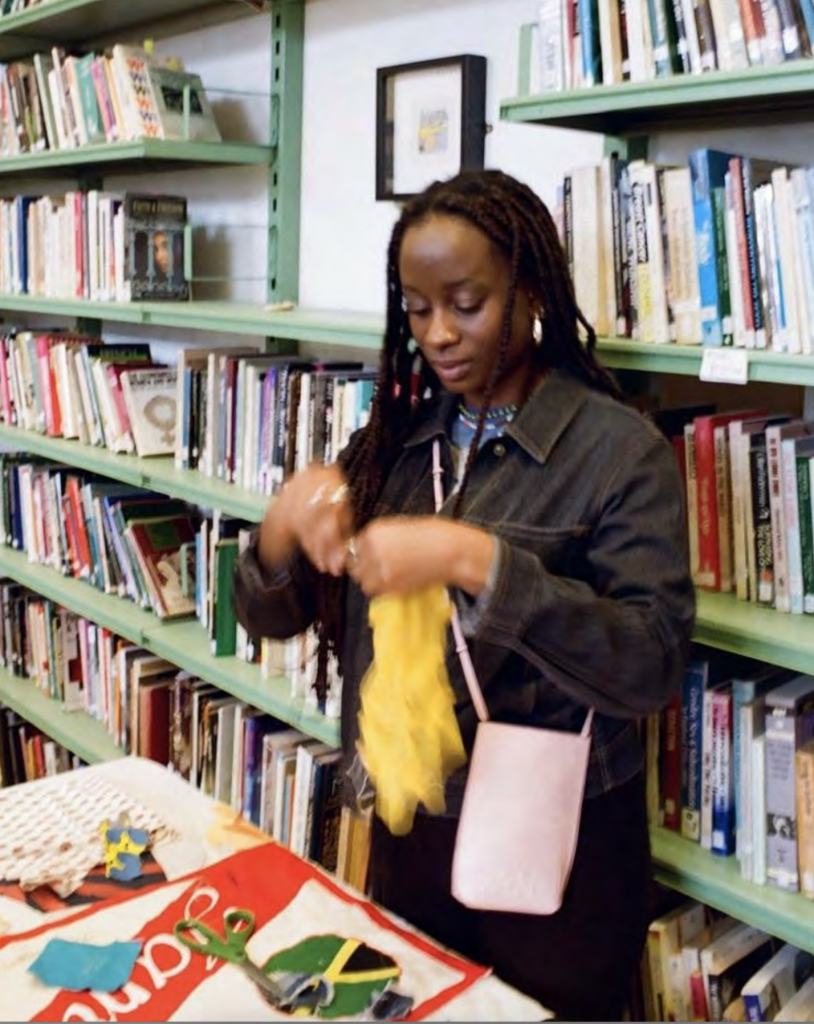
Halina Edwards studied BA (hons) textile design at Middlesex University and a fashion MA postgraduate at Westminster University. Her work at Westminster explored personal narratives on how creating flags can make us feel closer to home, although distant from our country of birth. Halina started her exploration of flags during the first year of her masters at the University of Westminster, London, after feeling homesick, the flags began by bringing things together that reminded her of her Jamaican upbringing in Dudley, England. The work has since developed into designs that speak about memory and connection. The flags are made using various techniques, such as natural dyeing, appliqué, paint and hand embroidery.
Since graduating from Westminster in 2021 Halina has taught textiles in workshops in intergenerational settings for galleries, fashion brands, cultural organizations and creative spaces. Originally teaching flag making through textiles in the workshops, she’s taught people how to spot the history of a country through the colours of its flag, its design composition, and techniques to design their own flag. Her workshops have further developed into textiles workshops, exploring textile techniques through fabric manipulation and appliqué.
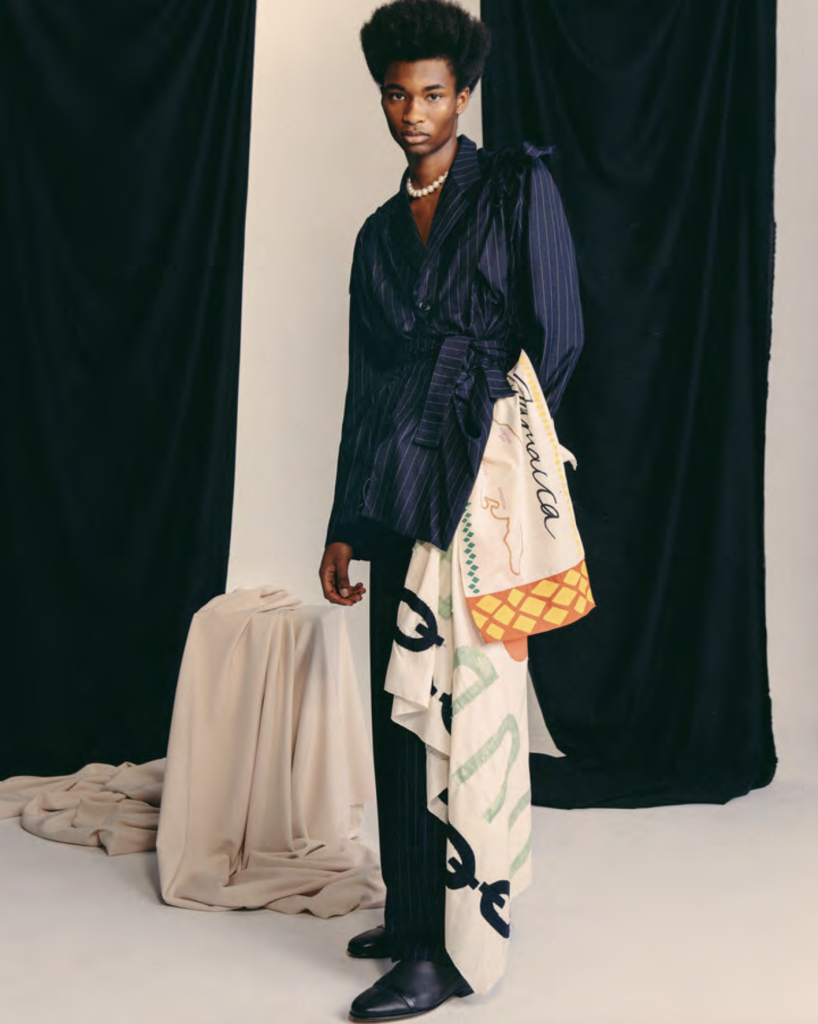
Above Image: 2018 – 2021, Flags About Home, Dudley and London, England.
Her clients include: Uniqlo, GANNI, Museum of the Home, Royal Opera House, Crafts Council, Focal Point Gallery, V&A East, South London Gallery, The Feminist Library, Dortmund-U,
HOME by Ronan McKenzie, Flock Together.
What brought Halina to my attention is her 2021 commission ‘A Place for Everyone’ a flag commissioned by Create London to commemorate the third year of Windrush Day. 2021 marked the 73rd anniversary of SS Empire Windrush arriving at Tilbury Docks, Essex in 1948. The flag is made from reflective fabric with the idea that when people are travelling throughout the day and night, the flag will always be seen, and will remind people of the history of Hackney and the Windrush generation living in the borough. The Hackney Windrush public programme is curated by Create London in partnership with Hackney Council, supported by Freelands Foundation.
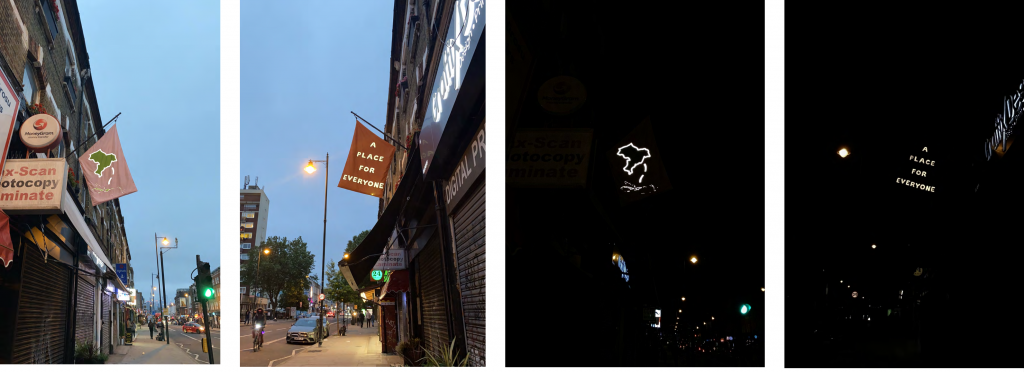
Above image: 2021, A Place for Everyone, Dalston. London
The Intervention workshop would be run within the programming of Block 1 of the academic year within Unit 5, September 2024. Resources would include the following:
- Textile waste/surplus
- Old magazines/editorials
- Basic sewing tools, needles threads, scissors etc
- Visiting lecturer/ practitioner (Halina Edwards)
The workshop would be a 3-hour workshop delivered by Halina with the support of myself, delivered twice over the duration of one day 10:00am -13:00 & 14:00 – 17:00 to a class of 30 students each session. The workshop would be broken down by the following activities:
- 30 min – PowerPoint presentation/ introduction of practice by Halina Edwards
- 60 mins -Students will be split into ten groups (3 students per group) and asked to individually begin to explore and gather visual representations of their positioning, community and values. Tutor’s will move from group to group to help facilitate the process.
- 60 mins – In their group’s students will create a combined identity flag.
- 30 mins – Studio show & tell presentation of flag workshop outcome.
Reflection
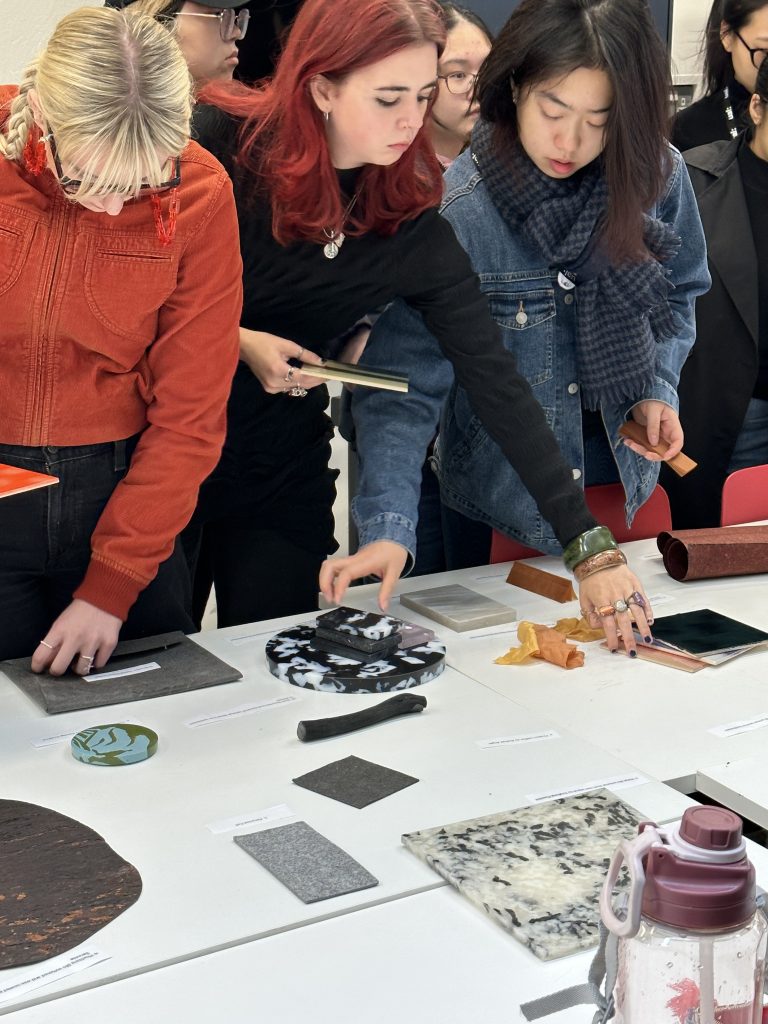
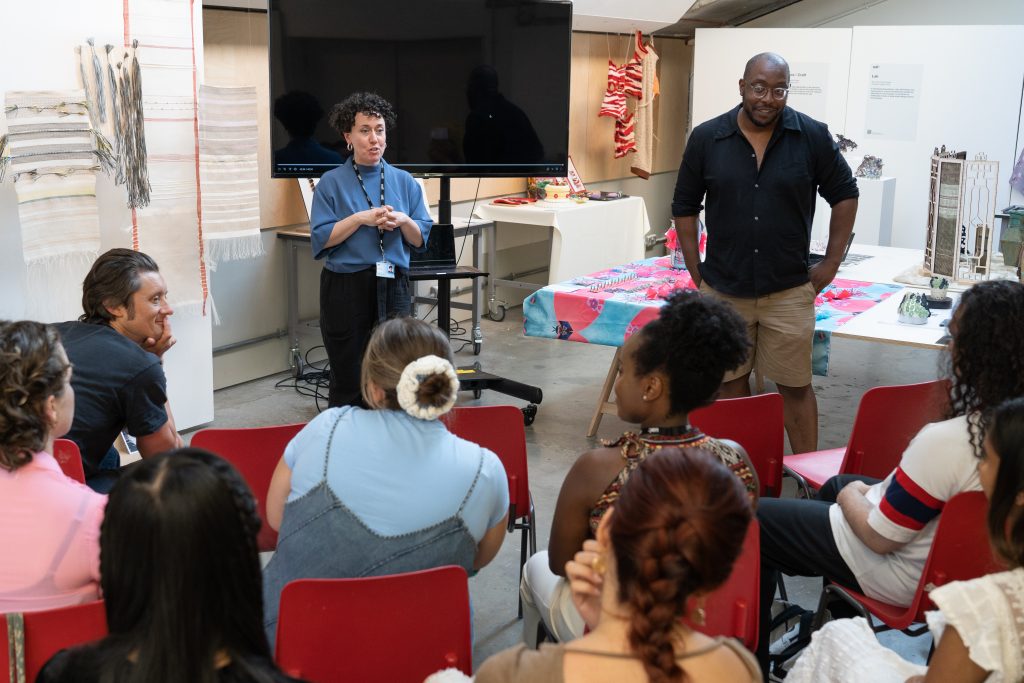
Image above : BATDY2 Students in a textile workshop.
How is the intervention inclusive?
- The intervention is designed to enable students to explore subjects of representation self-identity and positioning within design.
- Actively works towards localising diverse experiences, giving academic teams and individuals more ownership of discovering their cohorts unique diverse make up and making programme delivery of knowledge less centralised. Refer to Sadiq, A. (2023) Diversity, Equity & Inclusion, learning how to get it right.
- Facilitates group learning & storytelling, we learn through stories, having workshops that gets diverse student cohorts together sharing experiences is impactful as we learn through each other. Human interaction is the best learning we could ever have! Refer to Sadiq, A. (2023) Diversity, Equity & Inclusion, learning how to get it right.
- Actively promotes a culture of equality and empathy within the BATDY2 student cohort.
Feedback
After writing out the first iteration of my proposed intervention which took the form of creating a workshop within the programme delivery of BATDY2’s first unit of the academic year (Unit 5) that focuses on students creating there own intersectionality sports team/kit/flag I presented the idea to the wider textile team within our yearly planning meeting for the upcoming academic year programme for BATDY2. I got the following feedback.
- The majority of the team liked the U5 brief concept in general.
- A minority had issues with the outcome proposals, in particular the idea of students working toward creating a ‘sports team shirt’. I used football kits as an example of the concept providing examples of forward thinking, inclusive community kits given to me after discussions and feedback from my IPU tutor Annabel. The consensus from the minority was that the outcome was ‘too sporty’ and could alienate students who did not like sportswear design.
- The flag outcome was better received by all.
- It was also felt by the minority that the use of words such as ‘Intersectionality’ and ‘positioning’ could prove challenging within the workshop for students to comprehend, an explanation of these terminologys within the workshop could make the workshop ‘too academic presentation focus’ and less hands on practical which they felt was needed in the studio base learning for such a short unit (5 weeks total).
Reflections on team feedback
- I felt, at the time, a little deflated after our BATDY2 planning meeting to receive the feedback regarding the workshop being ‘too sporty’ or sports focused. I felt my colleagues who expressed this feeling were concentrating far too much on the ‘physical act of sport, rather than the ‘community aspect’ which is where it becomes a great catalyst for exploration of self -positioning.
- I also felt that my personal professional positioning as a sports footwear designer was clouding their judgement on the workshop proposal.
- I was concerned with their views on inclusive terminology.
After receiving the feedback from my colleagues within the BATD team I shared my intervention proposal with my IPU study group and tutor Annabel, also sharing the feedback received from my team. I gained the following productive feedback.
- Both my IPU peer group members and tutor thought the intervention was an engaging proposal for students to begin to explore their unique positioning and intersectionality within their practice.
- Both group peers were quite irritated by the BATD textile team minority reaction to the outcome proposal of a ‘sports team shirt’ and the subsequent conversation my football shirt references brought out.
- Annabel and my peers reassured and encouraged me to keep the outcome of a ‘Sports team shirt’ optional.
- It was pointed out and asked, after discussions with my peer group within our group show & tell sessions about the positioning and background of the individuals within the minority group within my team, was the challenge they had with the language because of their own unfamiliarity with terminology like ‘positionality’ and ‘intersectionality’.
Conclusion
I’ve found the entire process of creating and reflecting on an intervention within my practice that incorporates the learning I’ve gained from the IPU very impactful, engaging and rewarding. I’ve tried to learn from my peer feedback, workshops and tutorials, incorporating the learning into my intervention approach. As Asif Sadiq stated, when we think about learning in the diversity space it can’t be as a mere two-hour module, it has to be approached as a life long journey within education and the workplace. This is my experience and understanding of inclusive practices.
Bibliography
16-minute talk:
Sadiq, A. (2023) Diversity, Equity & Inclusion. Learning how to get it right. TEDx [Online}. Youtube. 2 March. Available at: https://www.youtube.com/watch?v=HR4wz1b54hw